MicroScale Thermophoresis (MST) Detection Service
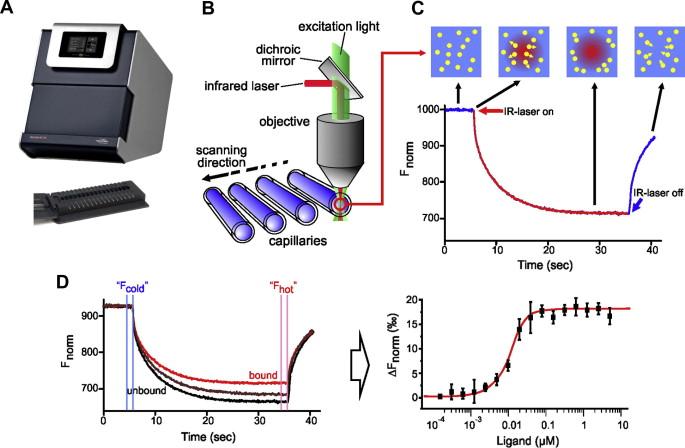
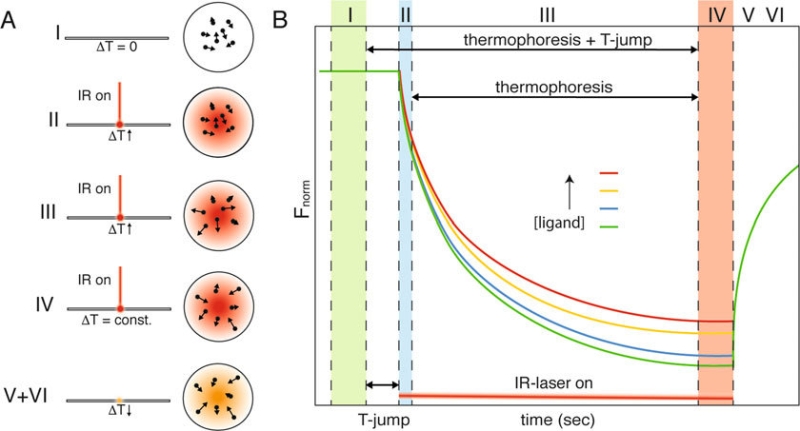
Microscale Thermophoresis (MST) is a technique for biomolecular interaction research by monitoring the migration behavior of biomolecules within a temperature gradient field. Based on fluorescent labeling, this technology precisely captures molecular movement variations induced by the thermophoretic effect, enabling highly sensitive quantitative analysis of binding affinity. MST establishes a localized temperature field in sample solutions via an infrared laser to characterize molecular interactions. During experiments, one molecule (e.g., a protein) is fluorescently labeled or fused with a GFP tag, then incubated with analyte molecules at serial concentrations in capillaries. Focused laser heating generates a temperature gradient across the irradiated area, driving directional molecular migration from high-temperature to low-temperature zones. The extent of migration is closely correlated with molecular mass, charge properties and intermolecular binding. By measuring fluorescent signals from labeled or intrinsically fluorescent molecules, the equilibrium dissociation constant Kd of molecular binding can be determined.