

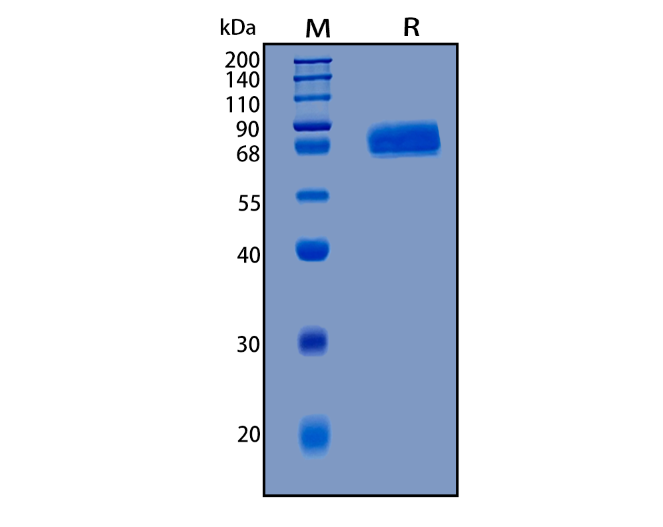
Analytical Data
-
Gene name
LACTb
- Application
-
Alternative Names
LACTb;MRPL56;Serine beta-lactamase-like Protein LACTB. mitochondrial
-
Species
Human
-
Source
E. coli
-
Tag
N-GST
-
Purity
Greater than 90% as determined by SDS-PAGE.
-
Uniprot
P83111
-
Expression Region
116-547aa
-
AA Sequence
HRIKD EVGAPGIVVG VSVDGKEVWS EGLGYADVEN RVPCKPETVM RIASISKSLT MVALAKLWEA GKLDLDIPVQ HYVPEFPEKE YEGEKVSVTT RLLISHLSGI RHYEKDIKKV KEEKAYKALK MMKENVAFEQ EKEGKSNEKN DFTKFKTEQE NEAKCRNSKP GKKKNDFEQG ELYLREKFEN SIESLRLFKN DPLFFKPGSQ FLYSTFGYTL LAAIVERASG CKYLDYMQKI FHDLDMLTTV QEENEPVIYN RARFYVYNKK KRLVNTPYVD NSYKWAGGGF LSTVGDLLKF GNAMLYGYQV GLFKNSNENL LPGYLKPETM VMMWTPVPNT EMSWDKEGKY AMAWGVVERK QTYGSCRKQR HYASHTGGAV GASSVLLVLP EELDTETINN KVPPRGIIVS IICNMQSVGL NSTALKIALE FDKDRSD
-
Molecular Weight
72kDa
-
Endotoxin
< 1.0 EU per μg protein as determined by the LAL method.
-
Form
Freeze-dried powder
-
Buffer formulation
PBS, pH7.4, containing 0.01% SKL, 1mM DTT, 5% Trehalose and Proclin300.
-
Reconstitution
Reconstitute in ddH2O to a concentration of 0.1-0.5 mg/mL. Do not vortex.
- Customization
-
Stability Test
The thermal stability is described by the loss rate. The loss rate was determined by accelerated thermal degradation test, that is, incubate the protein at 37℃ for 48h, and no obvious degradation and precipitation were observed. The loss rate isless than 8% within the expiration date under appropriate storage condition.
-
Storage & Shelf Life
Samples are stable for up to twelve months from date of receipt at -20℃ to -80℃. Store it under sterile conditions at -20℃ to -80℃. It is recommended that the protein be aliquoted for optimal storage. Avoid repeated freeze-thaw cycles.
-
Shipping
In general, recombinant proteins are supplied as lyophilized powder and shipped at ambient temperature. For bulk packages, the proteins are provided as frozen liquid and shipped with blue ice, unless otherwise requested by the customer.
Quality inspection process

Related Products
Identification
Protein Description
LACTB (Lactate Dehydrogenase A-C-terminal domain-binding protein) is a pivotal protein that has garnered attention for its role in various cellular processes, particularly in the context of cancer biology and metabolic regulation. Initially identified as a mitochondrial protein, LACTB has been implicated in the regulation of mitochondrial functions, including energy metabolism and apoptosis. Recent studies indicate that LACTB may play a crucial role in tumor suppression by modulating lactate metabolism and influencing the Warburg effect, where cancer cells preferentially utilize glycolysis over oxidative phosphorylation. Furthermore, research suggests that LACTB participates in the maintenance of mitochondrial homeostasis and cellular response to stress, highlighting its potential as a therapeutic target. The recombinant expression of LACTB facilitates a deeper understanding of its biochemical properties and interactions, enabling the investigation of its functional roles in cancer progression and metabolic disorders. As researchers explore the structure-function relationship of LACTB, insights gained from these studies could inform the development of targeted therapies aimed at re-establishing normal metabolic processes in cancer cells, thus providing a promising avenue for the treatment of various malignancies. Overall, the study of LACTB and its recombinant forms is essential for unraveling the complexities of cellular metabolism and identifying novel strategies for cancer intervention.







