Analytical Data
-
Gene name
RANKL/TNFSF11
-
简介
RANKL (TNFSF11), a type II transmembrane protein, is a receptor activator of NF-κB (RANK) ligand. RANKL is an activator of RANK. When binding to RANK, it induces the differentiation of monocyte/macrophage-lineage cells into osteoclasts and leads to osteoclast precursor maturation. RANKL is critical for osteoclasts maturation, bone modeling, and bone remodeling, as well as the development of lymph nodes (LNs). RANKL/TNFSF11 Protein, Mouse is a recombinant mouse RANKL (Q137-D316) without tag, which is produced in E.coli[1][2].
- Application
-
Biological Activity
1.Measured by its ability to induce osteoclast differentiation of RAW 264.7 mouse monocyte/macrophage cells. The ED50 is ≤1.192 ng/mL as measured by RAW 264.7 mouse monocyte/macrophage cells, corresponding to a specific activity of ≥8.39 × 10⁵ units/mg. 2. Measured by its binding ability in a functional ELISA. Immobilized mouse TNFSF11 at 10 μg/mL (100μL/well) can bind biotinylated Human TNFRSF11B. The ED50 for this effect is 0.0848 μg/mL. Measured by its ability to induce osteoclast differentiation of RAW 264.7 mouse monocyte/macrophage cells. The ED50 is <1>5.531 × 10⁵ units/mg. Measured by its binding ability in a functional ELISA. Immobilized mouse TNFSF11 at 10 μg/mL (100 μL/well) can bind biotinylated Human TNFRSF11B. The ED50 for this effect is 0.0848 μg/mL.
-
Alternative Names
rMuRANK L/TNFSF11; TRANCE; CD254
-
Species
Mouse
-
Source
E. coli
-
Tag
Tag Free
-
Purity
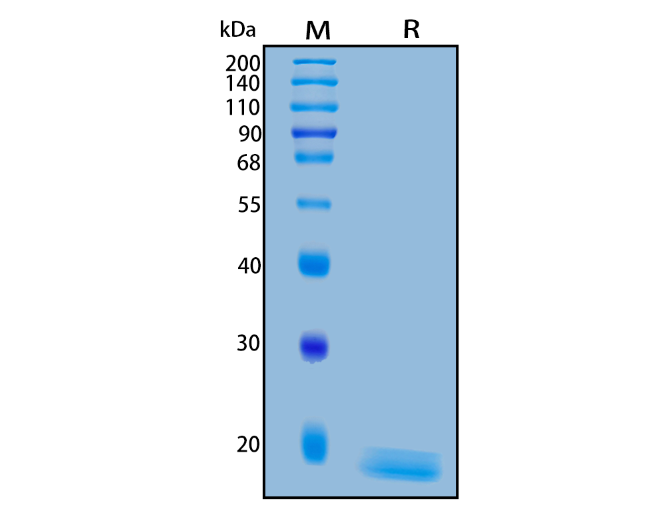
Greater than 90% as determined by SDS-PAGE.
-
Uniprot
O35235-1
-
Expression Region
Q137-D316
-
Protein Length
Partial
-
Molecular Weight
20 kDa
-
Endotoxin
< 1.0 EU per μg protein as determined by the LAL method.
-
Form
Freeze-dried powder
-
Buffer formulation
PBS, pH7.4, containing 0.01% SKL, 1mM DTT, 5% Trehalose and Proclin300.
-
Reconstitution
Reconstitute in ddH2O to a concentration of 0.1-0.5 mg/mL. Do not vortex.
- Customization
-
Stability Test
The thermal stability is described by the loss rate. The loss rate was determined by accelerated thermal degradation test, that is, incubate the protein at 37℃ for 48h, and no obvious degradation and precipitation were observed. The loss rate isless than 8% within the expiration date under appropriate storage condition.
-
Storage & Shelf Life
Samples are stable for up to twelve months from date of receipt at -20℃ to -80℃. Store it under sterile conditions at -20℃ to -80℃. It is recommended that the protein be aliquoted for optimal storage. Avoid repeated freeze-thaw cycles.
-
Shipping
In general, recombinant proteins are supplied as lyophilized powder and shipped at ambient temperature. For bulk packages, the proteins are provided as frozen liquid and shipped with blue ice, unless otherwise requested by the customer.
Quality inspection process