

Analytical Data
-
Gene name
Cathepsin B
-
简介
Cathepsin B Protein, a thiol protease, is crucial for intracellular protein degradation, cleaving matrix extracellular phosphoglycoprotein MEPE. It's implicated in solubilizing cross-linked TG/thyroglobulin in the thyroid follicle lumen. Associated with tumor invasion and metastasis, Cathepsin B signifies potential relevance in cancer-related pathways. Cathepsin B Protein, Human (L26V, HEK293, His) is the recombinant human-derived Cathepsin B protein, expressed by HEK293 , with C-His labeled tag and L26V mutation.
- Application
-
Biological Activity
Measured by its ability to cleave the fluorogenic peptide substrate Z-LR-AMC (HY-142021). Read at excitation and emission wavelengths of 380 nm and 460 nm. The specific activity is >2500 pmol/min/µg, as measured under the described conditions. (Activation description: The proenzyme needs to be activated in acid reducing buffer for an activated form.) Measured by its ability to cleave the fluorogenic peptide substrate Z-LR-AMC. Read at excitation and emission wavelengths of 380 nm and 460 nm . The specific activity is 13852.704 pmol/min/µg, as measured under the described conditions.
-
Alternative Names
CTSB; CPSB; APPS
-
Species
Human
-
Source
HEK293
-
Tag
C-His
-
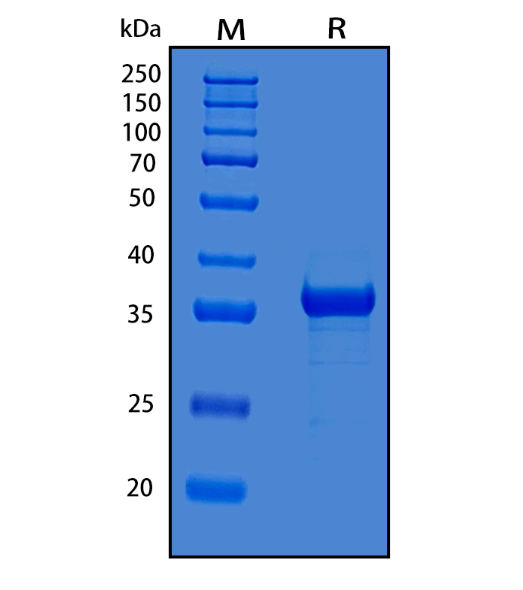
Purity
Greater than 95% as determined by SDS-PAGE.
-
Uniprot
P07858-1
-
Expression Region
R18-I339, L26V
-
AA Sequence
RSRPSFHPVSDELVNYVNKRNTTWQAGHNFYNVDMSYLKRLCGTFLGGPKPPQRVMFTEDLKLPASFDAREQWPQCPTIKEIRDQGSCGSCWAFGAVEAISDRICIHTNAHVSVEVSAEDLLTCCGSMCGDGCNGGYPAEAWNFWTRKGLVSGGLYESHVGCRPYSIPPCEHHVNGSRPPCTGEGDTPKCSKICEPGYSPTYKQDKHYGYNSYSVSNSEKDIMAEIYKNGPVEGAFSVYSDFLLYKSGVYQHVTGEMMGGHAIRILGWGVENGTPYWLVANSWNTDWGDNGFFKILRGQDHCGIESEVVAGIPRTDQYWEKI
-
Protein Length
Full Length of Isoform-1 Mature Protein
-
Molecular Weight
Observed band size: 40-45 &33 &26&18&10 kDa
-
Endotoxin
< 1.0 EU per μg protein as determined by the LAL method.
-
Form
Freeze-dried powder
-
Buffer formulation
PBS, pH7.4, containing 0.01% SKL, 1mM DTT, 5% Trehalose and Proclin300.
-
Reconstitution
Reconstitute in ddH2O to a concentration of 0.1-0.5 mg/mL. Do not vortex.
- Customization
-
Stability Test
The thermal stability is described by the loss rate. The loss rate was determined by accelerated thermal degradation test, that is, incubate the protein at 37℃ for 48h, and no obvious degradation and precipitation were observed. The loss rate isless than 8% within the expiration date under appropriate storage condition.
-
Storage & Shelf Life
Samples are stable for up to twelve months from date of receipt at -20℃ to -80℃. Store it under sterile conditions at -20℃ to -80℃. It is recommended that the protein be aliquoted for optimal storage. Avoid repeated freeze-thaw cycles.
-
Shipping
In general, recombinant proteins are supplied as lyophilized powder and shipped at ambient temperature. For bulk packages, the proteins are provided as frozen liquid and shipped with blue ice, unless otherwise requested by the customer.
Quality inspection process

Related Products
Protein Description
Cathepsin B is a cysteine protease that plays a crucial role in various biological processes, including protein degradation, apoptosis, and antigen presentation. It is primarily expressed in lysosomes but also found in other cellular compartments, indicating its multifaceted roles in cellular functions. Research has shown that Cathepsin B is implicated in numerous pathological conditions, including cancer progression, neurodegenerative diseases, and inflammatory disorders. Due to its involvement in these diseases, Cathepsin B is considered a potential therapeutic target, making its study increasingly relevant. The development of recombinant Cathepsin B proteins has enabled detailed investigations into its structure, function, and mechanisms of action. By producing these proteins in a controlled environment, researchers can analyze enzymatic activity, identify substrate specificity, and explore potential inhibitors that may modulate its activity for therapeutic purposes. Additionally, understanding the molecular mechanisms of Cathepsin B can provide insights into its role in disease progression and help in designing targeted therapies. As a result, the recombinant expression and characterization of Cathepsin B have become a vital area of research in biochemistry and pharmacology, with significant implications for drug development and disease treatment strategies.







