Analytical Data
-
Gene name
TFPI
-
简介
TFPI Protein inhibits factor X (Xa) directly and, in an Xa-dependent manner, hinders the activity of VIIa/tissue factor, possibly by forming a quaternary complex with Xa, TFPI, VIIa, and tissue factor. This multifunctional protein has antithrombotic properties and associates with lipoproteins in plasma, highlighting its crucial role in regulating the coagulation pathway. TFPI Protein, Rabbit (HEK293, His) is the recombinant Rabbit-derived TFPI protein, expressed by HEK293 , with N-10*His labeled tag.
- Application
-
Alternative Names
TFPI; tissue factor pathway inhibitor (lipoprotein-associated coagulation inhibitor); LACI; tissue factor pathway inhibitor; EPI; extrinsic pathway inhibitor; TFI; TFPI1; anti-convertin;
-
Species
Rabbit
-
Source
HEK293
-
Tag
N-10*His
-
Purity
Greater than 90% as determined by SDS-PAGE.
-
Uniprot
P19761
-
Expression Region
A25-T300
-
AA Sequence
AAEEDEEFTNITDIKPPLQKPTHSFCAMKVDDGPCRAYIKRFFFNILTHQCEEFIYGGCEGNENRFESLEECKEKCARDYPKMTTKLTFQKGKPDFCFLEEDPGICRGYITRYFYNNQSKQCERFKYGGCLGNLNNFESLEECKNTCENPTSDFQVDDHRTQLNTVNNTLINQPTKAPRRWAFHGPSWCLPPADRGLCQANEIRFFYNAIIGKCRPFKYSGCGGNENNFTSKKACITACKKGFIPKSIKGGLIKTKRKKKKQPVKITYVETFVKKT
-
Protein Length
Full Length of Mature Protein
-
Molecular Weight
55 kDa
-
Endotoxin
< 1.0 EU per μg protein as determined by the LAL method.
-
Form
Freeze-dried powder
-
Buffer formulation
PBS, pH7.4, containing 0.01% SKL, 1mM DTT, 5% Trehalose and Proclin300.
-
Reconstitution
Reconstitute in ddH2O to a concentration of 0.1-0.5 mg/mL. Do not vortex.
- Customization
-
Stability Test
The thermal stability is described by the loss rate. The loss rate was determined by accelerated thermal degradation test, that is, incubate the protein at 37℃ for 48h, and no obvious degradation and precipitation were observed. The loss rate isless than 8% within the expiration date under appropriate storage condition.
-
Storage & Shelf Life
Samples are stable for up to twelve months from date of receipt at -20℃ to -80℃. Store it under sterile conditions at -20℃ to -80℃. It is recommended that the protein be aliquoted for optimal storage. Avoid repeated freeze-thaw cycles.
-
Shipping
In general, recombinant proteins are supplied as lyophilized powder and shipped at ambient temperature. For bulk packages, the proteins are provided as frozen liquid and shipped with blue ice, unless otherwise requested by the customer.
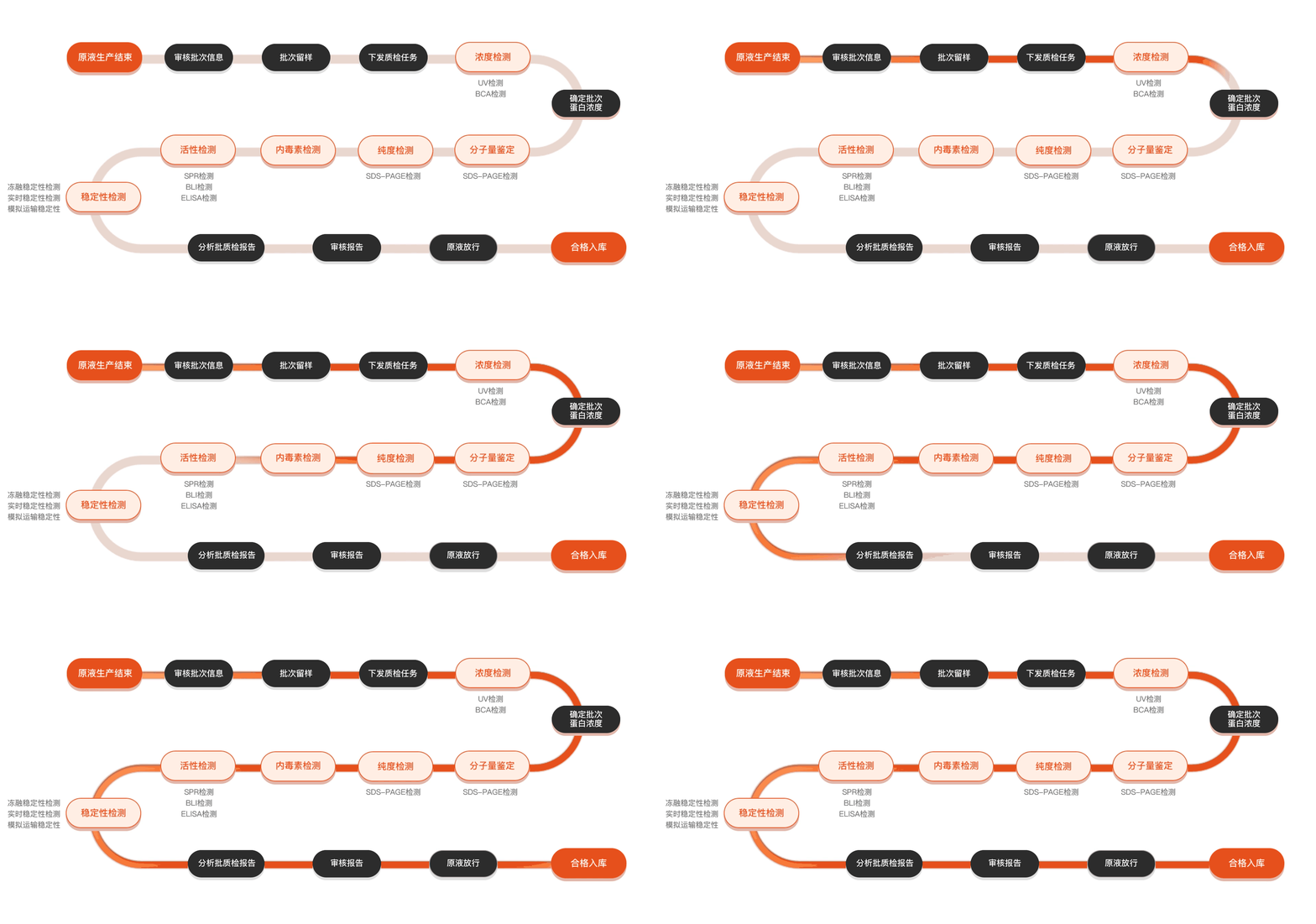
Quality inspection process
Related Products
Protein Description
Tissue factor pathway inhibitor (TFPI) is a critical regulator of the coagulation cascade, playing a vital role in maintaining hemostasis and preventing thrombosis. Discovered in the 1980s, TFPI acts primarily by inhibiting factor Xa and tissue factor (TF), thereby controlling the formation of the thrombin complex necessary for blood clotting. Given its central role in coagulation, researchers have focused on developing recombinant forms of TFPI for therapeutic applications. These recombinant proteins have potential use in treating various thromboembolic disorders, including deep vein thrombosis and pulmonary embolism, as well as in preventing clot formation in patients undergoing certain surgical procedures. The production of recombinant TFPI presents challenges, including ensuring proper folding, post-translational modifications, and bioactivity. Advances in biotechnology, such as genetic engineering techniques, have enabled the successful expression of TFPI in different host systems, including bacteria and mammalian cells. Recent studies have highlighted the efficacy of recombinant TFPI in preclinical models, demonstrating its ability to modulate coagulation pathways effectively. This progress paves the way for clinical trials aimed at evaluating its safety and efficacy, potentially offering new therapeutic avenues for patients at risk of thrombotic events. Overall, the research on TFPI recombinant proteins holds promise for enhancing our understanding of coagulation biology and developing targeted treatments for thrombotic diseases.