

Analytical Data
-
Gene name
AGRP
- Application
-
Alternative Names
AGRP;AGRT;ART;;Agouti-related Protein
-
Species
Human
-
Source
E. coli
-
Tag
His tag N-Terminus
-
Purity
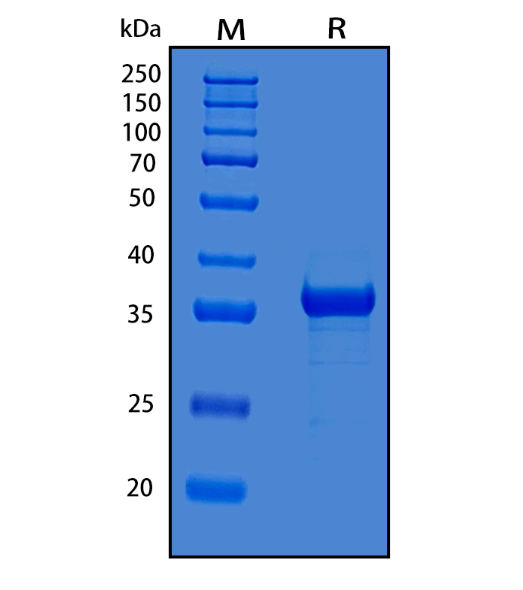
Greater than 90% as determined by SDS-PAGE.
-
Uniprot
O00253
-
Expression Region
21-132aa
-
AA Sequence
MGSSHHHHHHSSGLVPRGSHMGSHMAQMGLAPMEGIRRPDQALLPELPGL GLRAPLKKTTAEQAEEDLLQEAQALAEVLDLQDREPRSSRRCVRLHESCL GQQVPCCDPCATCYCRFFNAFCYCRKLGTAMNPCSRT
-
Molecular Weight
15 kDa
-
Endotoxin
< 1.0 EU per μg protein as determined by the LAL method.
-
Form
Freeze-dried powder
-
Buffer formulation
PBS, pH7.4, containing 0.01% SKL, 1mM DTT, 5% Trehalose and Proclin300.
-
Reconstitution
Reconstitute in ddH2O to a concentration of 0.1-0.5 mg/mL. Do not vortex.
- Customization
-
Stability Test
The thermal stability is described by the loss rate. The loss rate was determined by accelerated thermal degradation test, that is, incubate the protein at 37℃ for 48h, and no obvious degradation and precipitation were observed. The loss rate isless than 8% within the expiration date under appropriate storage condition.
-
Storage & Shelf Life
Samples are stable for up to twelve months from date of receipt at -20℃ to -80℃. Store it under sterile conditions at -20℃ to -80℃. It is recommended that the protein be aliquoted for optimal storage. Avoid repeated freeze-thaw cycles.
-
Shipping
In general, recombinant proteins are supplied as lyophilized powder and shipped at ambient temperature. For bulk packages, the proteins are provided as frozen liquid and shipped with blue ice, unless otherwise requested by the customer.
Quality inspection process

Related Products
Protein Description
Agouti-related protein (AGRP) is a neuropeptide primarily expressed in the arcuate nucleus of the hypothalamus, playing a crucial role in energy homeostasis and appetite regulation. Research on AGRP has gained momentum due to its involvement in obesity and metabolic disorders, conditions that represent significant public health challenges. AGRP acts as an antagonist to melanocyte-stimulating hormones (MSHs), promoting increased food intake and reduced energy expenditure. This dual role makes AGRP a potential therapeutic target for obesity treatments. The study of AGRP's structure, function, and interaction with other neuropeptides is critical to understanding its mechanisms in appetite regulation. Recent advances in recombinant protein technology have enabled the production of AGRP-related peptides, facilitating in vitro and in vivo studies to unravel its biological functions. These studies offer insights into the signaling pathways influenced by AGRP, helping to elucidate its contribution to the neurobiological basis of feeding behavior. Understanding the pathway of AGRP and its receptors could lead to innovative approaches in managing obesity and related metabolic disorders, making it a significant focus in both basic and clinical research contexts.







