

Analytical Data
-
Gene name
CBR3
- Application
-
Alternative Names
CBR3;SDR21C2;Carbonyl reductase [NADPH] 3
-
Species
Human
-
Source
E. coli
-
Tag
His tag N-Terminus
-
Purity
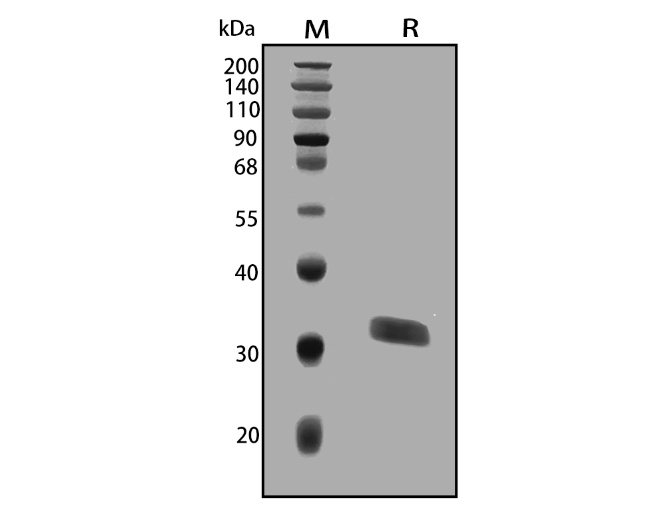
Greater than 90% as determined by SDS-PAGE.
-
Uniprot
O75828
-
Expression Region
1-277aa
-
AA Sequence
MSSCSRVALV TGANRGIGLA IARELCRQFS GDVVLTARDV ARGQAAVQQL QAEGLSPRFH QLDIDDLQSI RALRDFLRKE YGGLNVLVNN AAVAFKSDDP MPFDIKAEMT LKTNFFATRN MCNELLPIMK PHGRVVNISS LQCLRAFENC SEDLQERFHS ETLTEGDLVD LMKKFVEDTK NEVHEREGWP NSPYGVSKLG VTVLSRILAR RLDEKRKADR ILVNACCPGP VKTDMDGKDS IRTVEEGAET PVYLALLPPD ATEPQGQLVH DKVVQNW
-
Endotoxin
< 1.0 EU per μg protein as determined by the LAL method.
-
Form
Freeze-dried powder
-
Buffer formulation
PBS, pH7.4, containing 0.01% SKL, 1mM DTT, 5% Trehalose and Proclin300.
-
Reconstitution
Reconstitute in ddH2O to a concentration of 0.1-0.5 mg/mL. Do not vortex.
- Customization
-
Stability Test
The thermal stability is described by the loss rate. The loss rate was determined by accelerated thermal degradation test, that is, incubate the protein at 37℃ for 48h, and no obvious degradation and precipitation were observed. The loss rate isless than 8% within the expiration date under appropriate storage condition.
-
Storage & Shelf Life
Samples are stable for up to twelve months from date of receipt at -20℃ to -80℃. Store it under sterile conditions at -20℃ to -80℃. It is recommended that the protein be aliquoted for optimal storage. Avoid repeated freeze-thaw cycles.
-
Shipping
In general, recombinant proteins are supplied as lyophilized powder and shipped at ambient temperature. For bulk packages, the proteins are provided as frozen liquid and shipped with blue ice, unless otherwise requested by the customer.
Quality inspection process

Related Products
Protein Description
CBR3 (carbonyl reductase 3) is a key enzyme involved in the NADPH-dependent reduction of various carbonyl compounds, playing a significant role in drug metabolism and the detoxification processes within the human body. As a member of the short-chain dehydrogenase/reductase family, CBR3 has garnered attention for its ability to reduce harmful aldehydes and ketones, thus contributing to cellular protection against oxidative stress. Research into CBR3 has expanded in recent years due to its potential implications in pharmacology and toxicology, as variations in CBR3 activity can influence the metabolism of several therapeutic drugs, leading to diverse patient responses and potential adverse effects. Additionally, its involvement in diseases such as cancer and cardiovascular conditions highlights the need to understand its mechanistic pathways. The recombinant expression of CBR3 proteins in laboratory settings allows for detailed studies of its functional properties, substrate specificity, and interaction with various ligands. By elucidating these characteristics, researchers aim to develop better predictive models for drug interactions and to identify new therapeutic targets. As a result, CBR3 has become a focal point of study for those seeking to enhance drug efficacy and safety while mitigating side effects associated with pharmacotherapy.







