

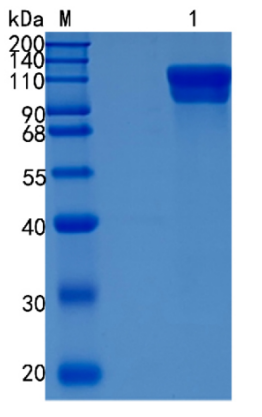
Analytical Data
-
Gene name
CA7
- Application
-
Alternative Names
CA7;Collagen alpha-1(VII) chain
-
Species
Human
-
Source
E. coli
-
Tag
His tag N-Terminus
-
Purity
Greater than 90% as determined by SDS-PAGE.
-
Uniprot
P43166
-
Expression Region
1-264aa
-
AA Sequence
MTGHHGWGYG QDDGPSHWHK LYPIAQGDRQ SPINIISSQA VYSPSLQPLE LSYEACMSLS ITNNGHSVQV DFNDSDDRTV VTGGPLEGPY RLKQFHFHWG KKHDVGSEHT VDGKSFPSEL HLVHWNAKKY STFGEAASAP DGLAVVGVFL ETGDEHPSMN RLTDALYMVR FKGTKAQFSC FNPKCLLPAS RHYWTYPGSL TTPPLSESVT WIVLREPICI SERQMGKFRS LLFTSEDDER IHMVNNFRPP QPLKGRVVKA SFRA
-
Molecular Weight
29.6 kDa
-
Endotoxin
< 1.0 EU per μg protein as determined by the LAL method.
-
Form
Freeze-dried powder
-
Buffer formulation
PBS, pH7.4, containing 0.01% SKL, 1mM DTT, 5% Trehalose and Proclin300.
-
Reconstitution
Reconstitute in ddH2O to a concentration of 0.1-0.5 mg/mL. Do not vortex.
- Customization
-
Stability Test
The thermal stability is described by the loss rate. The loss rate was determined by accelerated thermal degradation test, that is, incubate the protein at 37℃ for 48h, and no obvious degradation and precipitation were observed. The loss rate isless than 8% within the expiration date under appropriate storage condition.
-
Storage & Shelf Life
Samples are stable for up to twelve months from date of receipt at -20℃ to -80℃. Store it under sterile conditions at -20℃ to -80℃. It is recommended that the protein be aliquoted for optimal storage. Avoid repeated freeze-thaw cycles.
-
Shipping
In general, recombinant proteins are supplied as lyophilized powder and shipped at ambient temperature. For bulk packages, the proteins are provided as frozen liquid and shipped with blue ice, unless otherwise requested by the customer.
Quality inspection process

Related Products
Protein Description
CA7, or carbonic anhydrase 7, is a member of the carbonic anhydrase enzyme family, which plays a crucial role in various physiological processes by catalyzing the reversible conversion of carbon dioxide and water to bicarbonate and protons. This enzymatic activity is vital for maintaining acid-base balance, facilitating respiration, and regulating ion transport in cells. Research on CA7 has gained significance due to its potential implications in various health conditions, including renal disorders, metabolic syndromes, and certain types of cancers. The recombination and study of CA7 protein can provide insights into its enzymatic mechanisms and interactions, aiding in the design of inhibitors or therapeutic agents that target related pathways. Furthermore, understanding CA7’s structural properties and its functional role in different tissues may illuminate its contributions to pathophysiological states. Advances in recombinant protein technology have enabled researchers to produce and characterize CA7 in vitro, highlighting its significance in both basic research and clinical applications. The ability to manipulate CA7 expression and activity holds promise for developing innovative strategies for diagnosing and treating diseases linked to carbonic anhydrase dysfunction.







