

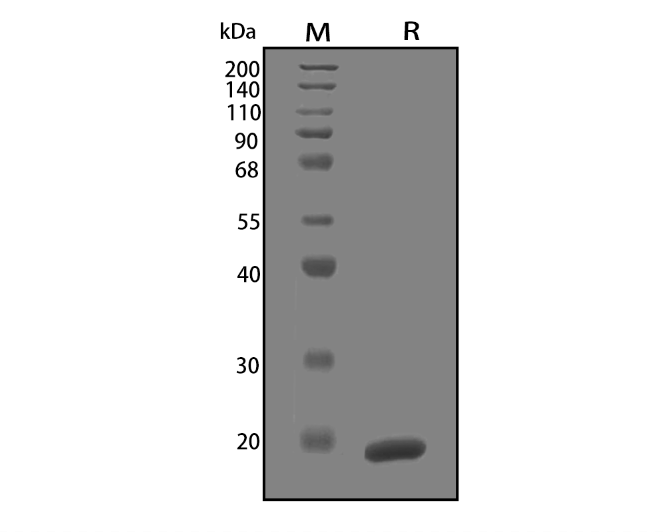
Analytical Data
-
Gene name
RRAGB
- Application
-
Alternative Names
RRAGB; Ras-related GTP-binding protein B; Rag B; RagB
-
Species
Human
-
Source
E. coli
-
Tag
His tag N-Terminus
-
Purity
Greater than 90% as determined by SDS-PAGE.
-
Uniprot
Q5VZM2
-
Expression Region
1-374 aa
-
AA Sequence
MEESDSEKTT EKENLGPRMD PPLGEPEGSL GWVLPNTAMK KKVLLMGKSG SGKTSMRSII FANYIARDTR RLGATILDRI HSLQINSSLS TYSLVDSVGN TKTFDVEHSH VRFLGNLVLN LWDCGGQDTF MENYFTSQRD NIFRNVEVLI YVFDVESREL EKDMHYYQSC LEAILQNSPD AKIFCLVHKM DLVQEDQRDL IFKEREEDLR RLSRPLECSC FRTSIWDETL YKAWSSIVYQ LIPNVQQLEM NLRNFAEIIE ADEVLLFERA TFLVISHYQC KEQRDAHRFE KISNIIKQFK LSCSKLAASF QSMEVRNSNF AAFIDIFTSN TYVMVVMSDP SIPSAATLIN IRNARKHFEK LERVDGPKQC LLMR
-
Molecular Weight
43.2 kDa
-
Endotoxin
< 1.0 EU per μg protein as determined by the LAL method.
-
Form
Freeze-dried powder
-
Buffer formulation
PBS, pH7.4, containing 0.01% SKL, 1mM DTT, 5% Trehalose and Proclin300.
-
Reconstitution
Reconstitute in ddH2O to a concentration of 0.1-0.5 mg/mL. Do not vortex.
- Customization
-
Stability Test
The thermal stability is described by the loss rate. The loss rate was determined by accelerated thermal degradation test, that is, incubate the protein at 37℃ for 48h, and no obvious degradation and precipitation were observed. The loss rate isless than 8% within the expiration date under appropriate storage condition.
-
Storage & Shelf Life
Samples are stable for up to twelve months from date of receipt at -20℃ to -80℃. Store it under sterile conditions at -20℃ to -80℃. It is recommended that the protein be aliquoted for optimal storage. Avoid repeated freeze-thaw cycles.
-
Shipping
In general, recombinant proteins are supplied as lyophilized powder and shipped at ambient temperature. For bulk packages, the proteins are provided as frozen liquid and shipped with blue ice, unless otherwise requested by the customer.
Quality inspection process

Related Products
Protein Description
RRAGB (Ras-related GTP-binding protein B) is a member of the Ras superfamily of GTPases, which play crucial roles in the regulation of various cellular processes, including cell growth, differentiation, and cytoskeletal dynamics. Research into RRAGB has gained momentum due to its significant involvement in the mTOR (mechanistic target of rapamycin) signaling pathway, a critical regulator of cellular metabolism and growth in response to nutrients. RRAGB functions primarily as a molecular switch, toggling between active and inactive forms based on GTP binding, and interacts with other proteins to facilitate signal transduction. Aberrant activation of RRAGB has been implicated in various pathological conditions, including cancer and metabolic disorders, highlighting its potential as a therapeutic target. Understanding the molecular mechanisms of RRAGB, including its regulatory interactions and downstream effects, could offer insights into novel strategies for targeting mTOR signaling in diseases characterized by dysregulated cellular growth and metabolism. As such, ongoing studies aim to elucidate the structural and functional aspects of RRAGB, paving the way for potential interventions that can modulate its activity in disease contexts.







