

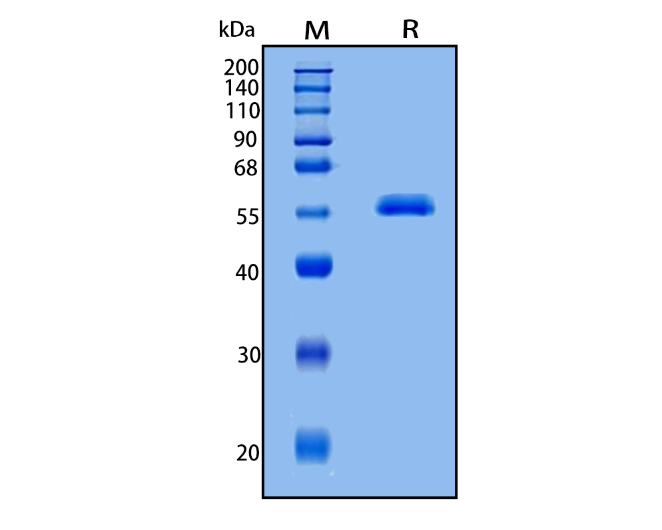
Analytical Data
-
Gene name
Scarb2
- Application
-
Alternative Names
Scarb2;CD36L2;Lysosome membrane Protein 2
-
Species
Human
-
Source
E. coli
-
Tag
N-6His+TRxA
-
Purity
Greater than 90% as determined by SDS-PAGE.
-
Uniprot
Q14108
-
Expression Region
28-433aa
-
AA Sequence
RVFQ KAVDQSIEKK IVLRNGTEAF DSWEKPPLPV YTQFYFFNVT NPEEILRGET PRVEEVGPYT YRELRNKANI QFGDNGTTIS AVSNKAYVFE RDQSVGDPKI DLIRTLNIPV LTVIEWSQVH FLREIIEAML KAYQQKLFVT HTVDELLWGY KDEILSLIHV FRPDISPYFG LFYEKNGTND GDYVFLTGED SYLNFTKIVE WNGKTSLDWW ITDKCNMING TDGDSFHPLI TKDEVLYVFP SDFCRSVYIT FSDYESVQGL PAFRYKVPAE ILANTSDNAG FCIPEGNCLG SGVLNVSICK NGAPIIMSFP HFYQADERFV SAIEGMHPNQ EDHETFVDIN PLTGIILKAA KRFQINIYVK KLDDFVETGD IRTMVFPVMY LNESVHIDKE TASRLKSMIN TT
-
Molecular Weight
56 kDa
-
Endotoxin
< 1.0 EU per μg protein as determined by the LAL method.
-
Form
Freeze-dried powder
-
Buffer formulation
PBS, pH7.4, containing 0.01% SKL, 1mM DTT, 5% Trehalose and Proclin300.
-
Reconstitution
Reconstitute in ddH2O to a concentration of 0.1-0.5 mg/mL. Do not vortex.
- Customization
-
Stability Test
The thermal stability is described by the loss rate. The loss rate was determined by accelerated thermal degradation test, that is, incubate the protein at 37℃ for 48h, and no obvious degradation and precipitation were observed. The loss rate isless than 8% within the expiration date under appropriate storage condition.
-
Storage & Shelf Life
Samples are stable for up to twelve months from date of receipt at -20℃ to -80℃. Store it under sterile conditions at -20℃ to -80℃. It is recommended that the protein be aliquoted for optimal storage. Avoid repeated freeze-thaw cycles.
-
Shipping
In general, recombinant proteins are supplied as lyophilized powder and shipped at ambient temperature. For bulk packages, the proteins are provided as frozen liquid and shipped with blue ice, unless otherwise requested by the customer.
Quality inspection process

Related Products
Identification
Protein Description
Scarb2, also known as scavenger receptor class B type 2, is a membrane protein implicated in lipid metabolism and cellular uptake of various molecules, including lipids and vitamins. Its role extends beyond lipid transport; it is also involved in immune response regulation and cellular signaling pathways. Research into Scarb2 has garnered attention due to its potential implications in various diseases, including metabolic disorders and cardiovascular diseases. Studies have indicated that altered Scarb2 expression is associated with obesity, diabetes, and atherosclerosis, suggesting a significant role in maintaining metabolic homeostasis. Furthermore, Scarb2's ability to mediate the uptake of specific lipophilic compounds presents opportunities for therapeutic applications, making it a promising target for drug delivery systems. Recent advances in recombinant protein technology have enabled the production and purification of Scarb2, facilitating detailed structural and functional analyses. Investigating the characteristics of recombinant Scarb2 can lead to a better understanding of its mechanisms in health and disease, opening avenues for developing novel interventions aimed at controlling lipid metabolism and enhancing therapeutic efficacy in related health issues. Overall, the study of recombinant Scarb2 is critical for elucidating its biological functions and therapeutic potential, positioning it as an important focal point in biomedical research.







