

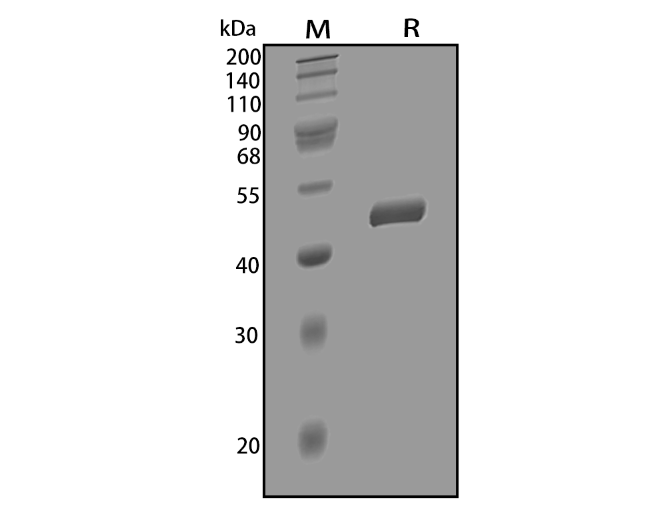
Analytical Data
-
Gene name
ARL1
- Application
-
Alternative Names
AKR1B10; AKR1B12; HIS; HSI; ALDRLn; Aldo-Keto Reductase Family 1,Member B10; Aldose Reductase-Related Protein; Small Intestine Reductase
-
Species
Human
-
Source
E. coli
-
Tag
N-His
-
Purity
Greater than 90% as determined by SDS-PAGE.
-
Uniprot
O60218
-
Expression Region
Met1~Tyr316
-
Molecular Weight
40kDa
-
Endotoxin
< 1.0 EU per μg protein as determined by the LAL method.
-
Form
Freeze-dried powder
-
Buffer formulation
PBS, pH7.4, containing 0.01% SKL, 1mM DTT, 5% Trehalose and Proclin300.
-
Reconstitution
Reconstitute in ddH2O to a concentration of 0.1-0.5 mg/mL. Do not vortex.
- Customization
-
Stability Test
The thermal stability is described by the loss rate. The loss rate was determined by accelerated thermal degradation test, that is, incubate the protein at 37℃ for 48h, and no obvious degradation and precipitation were observed. The loss rate isless than 8% within the expiration date under appropriate storage condition.
-
Storage & Shelf Life
Samples are stable for up to twelve months from date of receipt at -20℃ to -80℃. Store it under sterile conditions at -20℃ to -80℃. It is recommended that the protein be aliquoted for optimal storage. Avoid repeated freeze-thaw cycles.
-
Shipping
In general, recombinant proteins are supplied as lyophilized powder and shipped at ambient temperature. For bulk packages, the proteins are provided as frozen liquid and shipped with blue ice, unless otherwise requested by the customer.
Quality inspection process

Related Products
Protein Description
ARL1 (ADP-ribosylation factor-like 1) is a member of the Arf protein family, which plays a crucial role in various cellular processes, including vesicle trafficking, cytoskeletal dynamics, and membrane organization. This GTPase is particularly implicated in the regulation of Golgi dynamics and the transport of proteins between the Golgi apparatus and the plasma membrane. The study of ARL1 has gained attention due to its involvement in cellular mechanisms that are essential for proper cellular function and its potential link to various diseases, including cancer and neurodegenerative disorders. Understanding the function and regulation of ARL1 through recombinant protein studies can provide insights into its biochemical properties, interaction partners, and signaling pathways. The generation of ARL1 recombinant proteins enables detailed investigations into its GTPase activity, conformational changes, and the effects of post-translational modifications. Moreover, exploring ARL1's role in cellular processes under pathophysiological conditions can lead to the identification of novel therapeutic targets. Through structural and functional analyses, researchers aim to elucidate the molecular mechanisms by which ARL1 influences cellular homeostasis and its potential implications in disease contexts. The ongoing research on ARL1 and its recombinant protein forms is poised to contribute significantly to our understanding of this important GTPase and its role in health and disease.







