

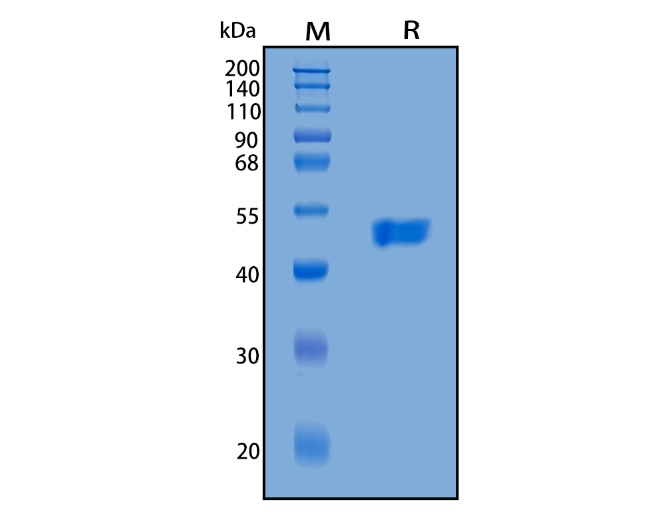
Analytical Data
-
Gene name
TFAP2E
- Application
-
Alternative Names
TFAP2ETranscription factor AP-2-epsilon; AP2-epsilon; Activating enhancer-binding Protein 2-epsilon
-
Species
Human
-
Source
E. coli
-
Tag
His tag N-Terminus
-
Purity
Greater than 90% as determined by SDS-PAGE.
-
Uniprot
Q6VUC0
-
Expression Region
1-442 aa
-
AA Sequence
MLVHTYSAME RPDGLGAAAG GARLSSLPQA AYGPAPPLCH TPAATAAAEF QPPYFPPPYP QPPLPYGQAP DAAAAFPHLA GDPYGGLAPL AQPQPPQAAW AAPRAAARAH EEPPGLLAPP ARALGLDPRR DYATAVPRLL HGLADGAHGL ADAPLGLPGL AAAPGLEDLQ AMDEPGMSLL DQSVIKKVPI PSKASSLSAL SLAKDSLVGG ITNPGEVFCS VPGRLSLLSS TSKYKVTVGE VQRRLSPPEC LNASLLGGVL RRAKSKNGGR CLRERLEKIG LNLPAGRRKA ANVTLLTSLV EGEAVHLARD FGYVCETEFP AKAAAEYLCR QHADPGELHS RKSMLLAAKQ ICKEFADLMA QDRSPLGNSR PALILEPGVQ SCLTHFSLIT HGFGGPAICA ALTAFQNYLL ESLKGLDKMF LSSVGSGHGE TKASEKDAKH RK
-
Molecular Weight
46.2 kDa
-
Endotoxin
< 1.0 EU per μg protein as determined by the LAL method.
-
Form
Freeze-dried powder
-
Buffer formulation
PBS, pH7.4, containing 0.01% SKL, 1mM DTT, 5% Trehalose and Proclin300.
-
Reconstitution
Reconstitute in ddH2O to a concentration of 0.1-0.5 mg/mL. Do not vortex.
- Customization
-
Stability Test
The thermal stability is described by the loss rate. The loss rate was determined by accelerated thermal degradation test, that is, incubate the protein at 37℃ for 48h, and no obvious degradation and precipitation were observed. The loss rate isless than 8% within the expiration date under appropriate storage condition.
-
Storage & Shelf Life
Samples are stable for up to twelve months from date of receipt at -20℃ to -80℃. Store it under sterile conditions at -20℃ to -80℃. It is recommended that the protein be aliquoted for optimal storage. Avoid repeated freeze-thaw cycles.
-
Shipping
In general, recombinant proteins are supplied as lyophilized powder and shipped at ambient temperature. For bulk packages, the proteins are provided as frozen liquid and shipped with blue ice, unless otherwise requested by the customer.
Quality inspection process

Related Products
Protein Description
Transcription factor AP-2 epsilon (TFAP2E) is a member of the AP-2 family of transcription factors, which play crucial roles in the regulation of gene expression during development and cellular differentiation. This protein is particularly important in the context of embryonic development and tissue-specific gene regulation. Recent studies have shown that TFAP2E is involved in various biological processes, including cell proliferation, apoptosis, and the maintenance of pluripotency in stem cells. Its expression is observed in multiple tissues, suggesting a broader role in developmental biology. Furthermore, dysregulation of TFAP2E has been implicated in various diseases, including cancer, where it may influence tumor progression and metastasis by modulating key signaling pathways. The development of recombinant TFAP2E protein is essential for elucidating its functional mechanisms and interactions with other cellular components. This recombinant protein can be utilized in biochemical assays, structural studies, and functional analyses to better understand its role in transcriptional regulation and its potential implications in health and disease. The exploration of TFAP2E not only advances our knowledge of transcriptional regulation but also opens avenues for therapeutic interventions targeting diseases linked to its dysfunction. Overall, ongoing research into TFAP2E and its recombinant protein form is vital for unraveling the complexities of gene regulation and developing innovative strategies for disease treatment.







