

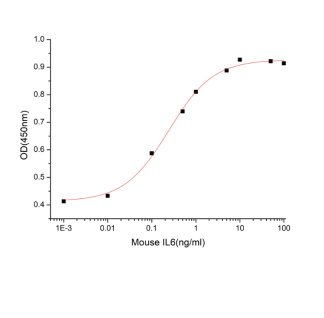
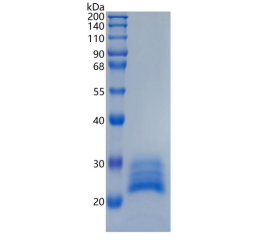
Analytical Data
-
Gene name
IL-6
- Application
-
Alternative Names
IL-6;Interleukin-6 receptor subunit alpha
-
Species
Mouse
-
Source
HEK293
-
Tag
C-His
-
Purity
Greater than 95% as determined by SDS-PAGE.
-
Uniprot
P08505
-
Molecular Weight
25-35 kDa as determined by SDS-PAGE reducing conditions.
-
Endotoxin
< 1.0 EU per μg protein as determined by the LAL method.
-
Form
Freeze-dried powder
-
Buffer formulation
liquid from a 0.22 μm filtered solution of PBS, pH 7.4, 5 % trehalose, 5 %mannitol.
-
Reconstitution
Reconstitute in ddH2O to a concentration of 0.1-0.5 mg/mL. Do not vortex.
- Customization
-
Stability Test
The thermal stability is described by the loss rate. The loss rate was determined by accelerated thermal degradation test, that is, incubate the protein at 37℃ for 48h, and no obvious degradation and precipitation were observed. The loss rate isless than 8% within the expiration date under appropriate storage condition.
-
Storage & Shelf Life
Samples are stable for up to twelve months from date of receipt at -20℃ to -80℃. Store it under sterile conditions at -20℃ to -80℃. It is recommended that the protein be aliquoted for optimal storage. Avoid repeated freeze-thaw cycles.
-
Shipping
In general, recombinant proteins are supplied as lyophilized powder and shipped at ambient temperature. For bulk packages, the proteins are provided as frozen liquid and shipped with blue ice, unless otherwise requested by the customer.
Quality inspection process

Related Products
Identification
Protein Description
Interleukin-6 (IL-6) is a multifunctional cytokine involved in various physiological and pathological processes, including immune response, inflammation, and hematopoiesis. It plays a crucial role in the body’s defense mechanisms, particularly during infections and injuries. However, dysregulation of IL-6 production is linked to a variety of diseases, such as autoimmune disorders, chronic inflammatory conditions, and cancers. Due to its central role in inflammation and immune response, IL-6 has emerged as a significant target for therapeutic intervention. Recombinant IL-6 protein has been studied for its potential applications in both basic research and clinical settings, offering insights into cytokine signaling pathways and the development of targeted therapies. Researchers are particularly interested in its role in promoting T cell differentiation, modulating immune responses, and its potential utility in cell-based therapies. Furthermore, understanding the structure-function relationship of IL-6 can facilitate the design of more effective inhibitors or agonists for therapeutic purposes. As such, the study of recombinant IL-6 protein not only contributes to fundamental biological knowledge but also paves the way for innovative treatments for diseases characterized by altered IL-6 signaling.







