Analytical Data
-
Gene name
Contactin-2/CNTN2
-
简介
Contactin-2/CNTN2 Protein collaborates with transmembrane protein CNTNAP2, crucially organizing axonal domains at nodes of Ranvier.This partnership maintains voltage-gated potassium channels at the juxtaparanodal region, emphasizing Contactin-2's pivotal role in the intricate molecular architecture essential for efficient nerve impulse propagation along myelinated axons.Contactin-2/CNTN2 Protein, Mouse (HEK293, His) is the recombinant mouse-derived Contactin-2/CNTN2 protein, expressed by HEK293 , with C-His labeled tag.
- Application
-
Biological Activity
Measured in a cell proliferation assay using SH-SY5Y cells. The ED50 for this effect is ≤1.421 μg/mL, corresponding to a specific activity is ≥703.729 units/mg. Measured in a cell proliferation assay using SH-SY5Y cells. The ED50 for this effect is 1.421 μg/ml, corresponding to a specific activity is 703.729 units/mg.
-
Alternative Names
Contactin-2; Axonal glycoprotein TAG-1; Axonin-1; Transient axonal glycoprotein 1; CNTN2; AXT; TAG1; TAX1
-
Species
Mouse
-
Source
HEK293
-
Tag
C-10*His
-
Purity
Greater than 95% as determined by SDS-PAGE.
-
Uniprot
Q61330
-
Expression Region
Q31-E1013
-
AA Sequence
QGTPATFGPVFEEQPVGLLFPEESAEDQVTLACRARASPPATYRWKMNGTEMNLEPGSRHQLMGGNLVIMSPTKAQDAGVYQCLASNPVGTVVSKEAVLRFGFLQEFSKEERDPVKTHEGWGVMLPCNPPAHYPGLSYRWLLNEFPNFIPTDGRHFVSQTTGNLYIARTNASDLGNYSCLATSHLDFSTKSVFSKFAQLNLAAEDPRLFAPSIKARFPPETYALVGQQVTLECFAFGNPVPRIKWRKVDGSLSPQWGTAEPTLQIPSVSFEDEGTYECEAENSKGRDTVQGRIIVQAQPEWLKVISDTEADIGSNLRWGCAAAGKPRPMVRWLRNGEPLASQNRVEVLAGDLRFSKLNLEDSGMYQCVAENKHGTIYASAELAVQALAPDFRQNPVRRLIPAARGGEISIPCQPRAAPKATILWSKGTEILGNSTRVTVTLDGTLIIRNISRSDEGKYTCFAENFMGKANSTGILSVRDATKITLAPSSADINVGDNLTLQCHASHDPTMDLTFTWTLDDFPVDFDKPGGHYRRASVKETIGDLTILNAQLRHGGTYTCMAQTVVDGASKEATVLVRGPPGPPGGVVVRDIGDTTVQLSWSRGFDNHSPIAKYTLQARTPPSGKWKQVRTNPVNIEGNAETAQVLGLMPWMDYEFRVSASNILGTGEPSGPSSRIRTKEAVPSVAPSGLSGGGGAPGELTINWTPMSREYQNGDGFGYLLSFRRQGSSSWQTARVPGADTQYFVYSNDSIHPYTPFEVKIRSYNRRGDGPESLTAIVYSAEEEPKVAPAKVWAKGSSSSEMNVSWEPVLQDMNGILLGYEIRYWKAGDKEAAADRVRTAGLDSSARVTGLYPNTKYHVTVRAYNRAGTGPASPSADAMTMKPPPRRPPGNISWTFSSSSLSLKWDPVVPLRNESTVTGYKMLYQNDLQPTPMLHLTSKNWIEIPVPEDIGHALVQIRTTGPGGDGIPAEVHIVRNGGTSMMVE
-
Protein Length
Partial
-
Molecular Weight
128-135 kDa.
-
Endotoxin
< 1.0 EU per μg protein as determined by the LAL method.
-
Form
Freeze-dried powder
-
Buffer formulation
PBS, pH7.4, containing 0.01% SKL, 1mM DTT, 5% Trehalose and Proclin300.
-
Reconstitution
Reconstitute in ddH2O to a concentration of 0.1-0.5 mg/mL. Do not vortex.
- Customization
-
Stability Test
The thermal stability is described by the loss rate. The loss rate was determined by accelerated thermal degradation test, that is, incubate the protein at 37℃ for 48h, and no obvious degradation and precipitation were observed. The loss rate isless than 8% within the expiration date under appropriate storage condition.
-
Storage & Shelf Life
Samples are stable for up to twelve months from date of receipt at -20℃ to -80℃. Store it under sterile conditions at -20℃ to -80℃. It is recommended that the protein be aliquoted for optimal storage. Avoid repeated freeze-thaw cycles.
-
Shipping
In general, recombinant proteins are supplied as lyophilized powder and shipped at ambient temperature. For bulk packages, the proteins are provided as frozen liquid and shipped with blue ice, unless otherwise requested by the customer.
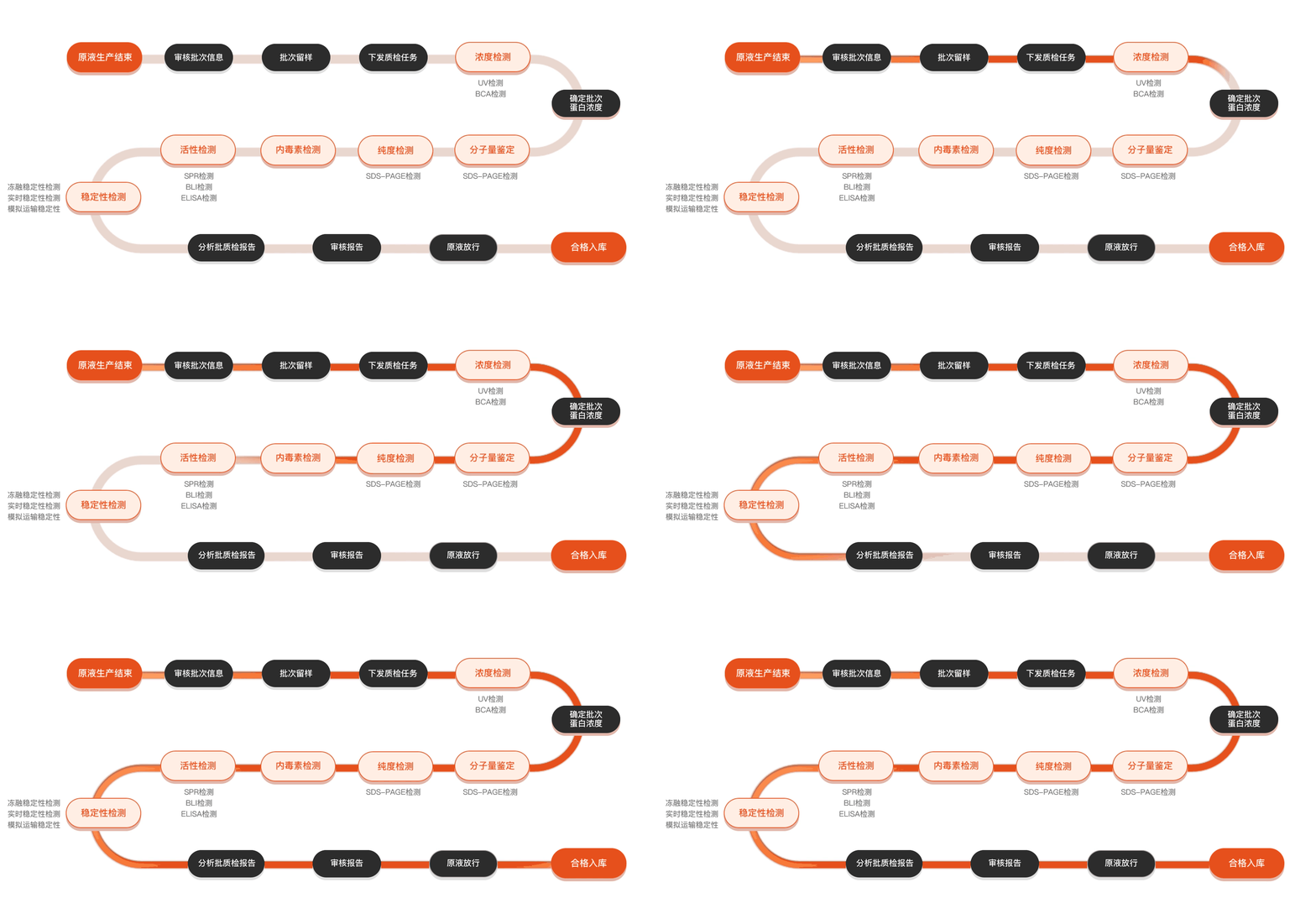
Quality inspection process
Related Products
Protein Description
Contactin-2 (CNTN2) is a member of the contactin family, which plays a crucial role in the development and function of the nervous system. It is a glycosylphosphatidylinositol (GPI)-anchored protein found on the surface of neurons and is involved in axon-glial interactions, myelination, and synaptic function. Research has shown that CNTN2 interacts with various neuronal cell types and extracellular matrix components, influencing neuronal adhesion, migration, and signaling pathways. Abnormal expression or dysfunction of CNTN2 has been linked to several neurological disorders, including autism spectrum disorders, schizophrenia, and multiple sclerosis. Therefore, the recombinant expression of CNTN2 is of great interest for both basic neuroscience research and potential therapeutic applications. By producing a functional CNTN2 protein through recombinant biotechnology, researchers can study its role in cell adhesion and signaling, investigate its molecular interactions, and explore its potential as a biomarker or target for neurodevelopmental and neurodegenerative diseases. Understanding the precise mechanisms of CNTN2 may offer insights into its contributions to neuronal health and disease, paving the way for novel interventions in neurobiology.