

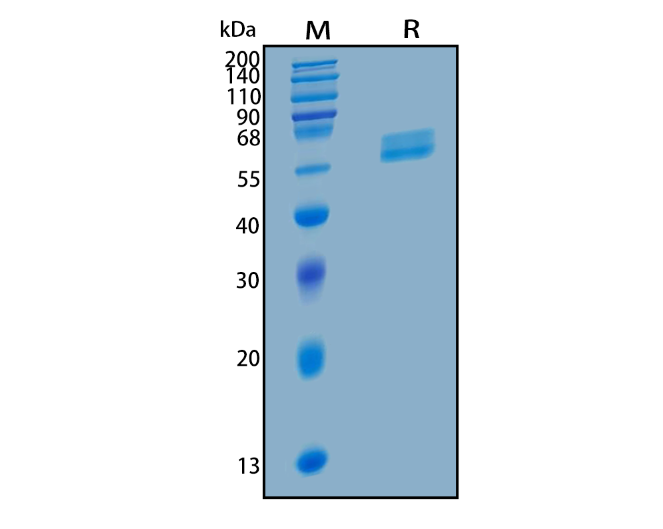
Analytical Data
-
Gene name
PROLM25
- Application
-
Species
Oryza sativa subsp. japonica
-
Source
E. coli
-
Tag
N- His
-
Purity
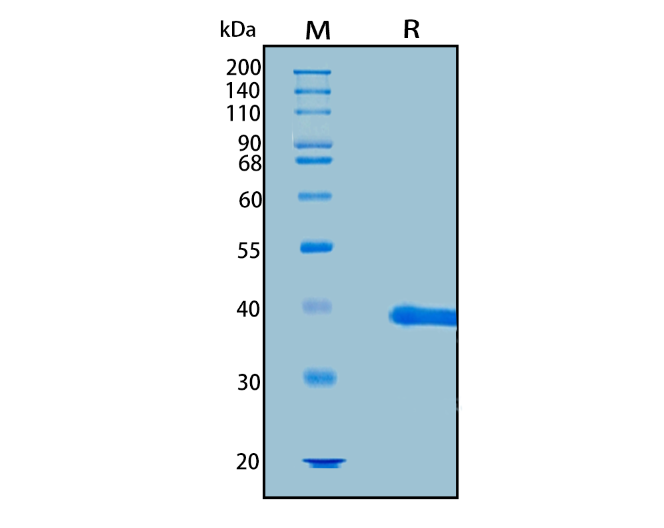
Greater than 90% as determined by SDS-PAGE.
-
Uniprot
P17048
-
Expression Region
20-156aa
-
Molecular Weight
21.9 kDa
-
Endotoxin
< 1.0 EU per μg protein as determined by the LAL method.
-
Form
Freeze-dried powder
-
Buffer formulation
PBS, pH7.4, containing 0.01% SKL, 1mM DTT, 5% Trehalose and Proclin300.
-
Reconstitution
Reconstitute in ddH2O to a concentration of 0.1-0.5 mg/mL. Do not vortex.
- Customization
-
Stability Test
The thermal stability is described by the loss rate. The loss rate was determined by accelerated thermal degradation test, that is, incubate the protein at 37℃ for 48h, and no obvious degradation and precipitation were observed. The loss rate isless than 8% within the expiration date under appropriate storage condition.
-
Storage & Shelf Life
Samples are stable for up to twelve months from date of receipt at -20℃ to -80℃. Store it under sterile conditions at -20℃ to -80℃. It is recommended that the protein be aliquoted for optimal storage. Avoid repeated freeze-thaw cycles.
-
Shipping
In general, recombinant proteins are supplied as lyophilized powder and shipped at ambient temperature. For bulk packages, the proteins are provided as frozen liquid and shipped with blue ice, unless otherwise requested by the customer.
Quality inspection process

Related Products
Protein Description
PROLM25 is a recombinant protein that has garnered significant interest in the field of molecular biology and biotechnology due to its potential applications in various therapeutic and industrial processes. Originally isolated from a specific organism, PROLM25 exhibits unique structural and functional properties that make it a valuable candidate for research. Its ability to interact with specific biological targets suggests a role in cellular signaling, making it a focal point for studies aimed at understanding complex biological pathways. Researchers are investigating its mechanisms of action to explore how PROLM25 can be utilized in drug development, particularly in the treatment of diseases where traditional therapies are ineffective. Additionally, the recombinant expression of PROLM25 allows for the production of large quantities of the protein, facilitating extensive studies on its functional characteristics. Advances in protein engineering techniques are further enhancing our ability to modify PROLM25 to improve its efficacy and specificity, paving the way for innovative therapeutic applications. The growing body of research surrounding PROLM25 reflects its promise in the growing fields of personalized medicine and biopharmaceuticals, highlighting the importance of detailed structural and functional analyses in the quest for new, effective treatment options.







