

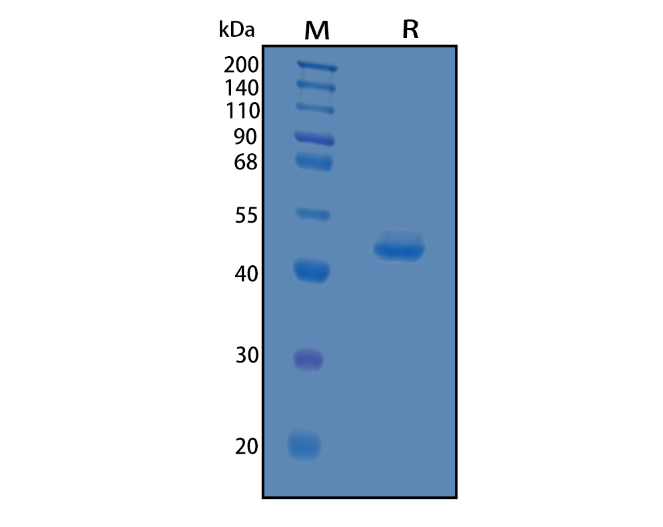
Analytical Data
-
Gene name
A1AT
- Application
-
Alternative Names
Alpha-1 antiproteinase (Serine proteinase inhibitor), PI, A1A, AAT, PI1, A1AT, MGC9222, PRO2275, MGC23330, SERP1NA1 .
-
Species
Human
-
Source
E. coli
-
Tag
N-6His
-
Purity
Greater than 90% as determined by SDS-PAGE.
-
Uniprot
P01009
-
Expression Region
25-418aa
-
AA Sequence
EDPQGDAAQK TDTSHHDQDH PTFNKITPNL AEFAFSLYRQ LAHQSNSTNI FFSPVSIATA FAMLSLGTKA DTHDEILEGL NFNLTEIPEA QIHEGFQELL RTLNQPDSQL QLTTGNGLFL SEGLKLVDKF LEDVKKLYHS EAFTVNFGDT EEAKKQINDY VEKGTQGKIV DLVKELDRDT VFALVNYIFF KGKWERPFEV KDTEEEDFHV DQVTTVKVPM MKRLGMFNIQ HCKKLSSWVL LMKYLGNATA IFFLPDEGKL QHLENELTHD IITKFLENED RRSASLHLPK LSITGTYDLK SVLGQLGITK VFSNGADLSG VTEEAPLKLS KAVHKAVLTI DEKGTEAAGA MFLEAIPMSI PPEVKFNKPF VFLMIEQNTK SPLFMGKVVN PTQK
-
Molecular Weight
48 kDa
-
Endotoxin
< 1.0 EU per μg protein as determined by the LAL method.
-
Form
Freeze-dried powder
-
Buffer formulation
PBS, pH7.4, containing 0.01% SKL, 1mM DTT, 5% Trehalose and Proclin300.
-
Reconstitution
Reconstitute in ddH2O to a concentration of 0.1-0.5 mg/mL. Do not vortex.
- Customization
-
Stability Test
The thermal stability is described by the loss rate. The loss rate was determined by accelerated thermal degradation test, that is, incubate the protein at 37℃ for 48h, and no obvious degradation and precipitation were observed. The loss rate isless than 8% within the expiration date under appropriate storage condition.
-
Storage & Shelf Life
Samples are stable for up to twelve months from date of receipt at -20℃ to -80℃. Store it under sterile conditions at -20℃ to -80℃. It is recommended that the protein be aliquoted for optimal storage. Avoid repeated freeze-thaw cycles.
-
Shipping
In general, recombinant proteins are supplied as lyophilized powder and shipped at ambient temperature. For bulk packages, the proteins are provided as frozen liquid and shipped with blue ice, unless otherwise requested by the customer.
Quality inspection process

Related Products
Identification
Protein Description
Alpha-1 antitrypsin (A1AT) is a key protein synthesized in the liver that plays a crucial role in protecting tissues from enzymes of inflammatory cells, particularly neutrophil elastase. Deficiency in A1AT can lead to severe lung diseases, such as emphysema and chronic obstructive pulmonary disease (COPD), and liver disorders, including cirrhosis. The inheritance of A1AT deficiency occurs due to mutations in the SERPINA1 gene, leading to a range of phenotypes, the most common being the PiZZ genotype associated with significant clinical manifestations. Recent advancements in biotechnology have paved the way for the development of recombinant A1AT proteins to treat A1AT deficiency. These recombinant proteins are engineered to enhance stability, bioavailability, and functional activity in the body. Research has focused on optimizing the expression systems for producing A1AT, such as using mammalian cells or yeast, which can yield properly glycosylated and functional proteins. Clinical studies have indicated that recombinant A1AT therapy can improve lung function and reduce the incidence of liver damage in affected individuals. Ongoing research aims to refine the production processes, assess long-term efficacy, and explore the potential of A1AT as a therapeutic agent beyond deficiency-related diseases, including its anti-inflammatory and tissue-protective properties in various conditions such as cystic fibrosis and chronic inflammatory diseases. The growing understanding of A1AT's mechanisms of action and potential therapeutic applications underscores the importance of continued research in this area for developing novel treatment strategies to improve patient outcomes.







