

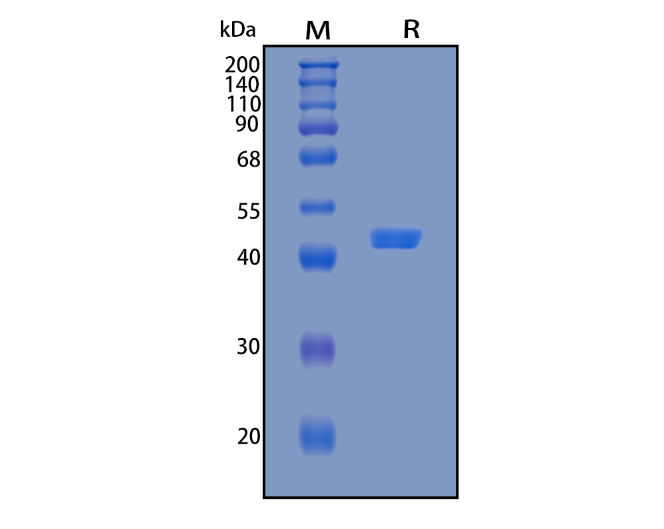
Analytical Data
-
Gene name
DUSP5
- Application
-
Alternative Names
DUSP5;VH3;Dual specificity Protein phosphatase 5
-
Species
Human
-
Source
E. coli
-
Tag
His tag N-Terminus
-
Purity
Greater than 90% as determined by SDS-PAGE.
-
Uniprot
Q16690
-
Expression Region
1-384aa
-
AA Sequence
MKVTSLDGRQ LRKMLRKEAA ARCVVLDCRP YLAFAASNVR GSLNVNLNSV VLRRARGGAV SARYVLPDEA ARARLLQEGG GGVAAVVVLD QGSRHWQKLR EESAARVVLT SLLACLPAGP RVYFLKGGYE TFYSEYPECC VDVKPISQEK IESERALISQ CGKPVVNVSY RPAYDQGGPV EILPFLYLGS AYHASKCEFL ANLHITALLN VSRRTSEACA THLHYKWIPV EDSHTADISS HFQEAIDFID CVREKGGKVL VHCEAGISRS PTICMAYLMK TKQFRLKEAF DYIKQRRSMV SPNFGFMGQL LQYESEILPS TPNPQPPSCQ GEAAGSSLIG HLQTLSPDMQ GAYCTFPASV LAPVPTHSTV SELSRSPVAT ATSC
-
Endotoxin
< 1.0 EU per μg protein as determined by the LAL method.
-
Form
Freeze-dried powder
-
Buffer formulation
PBS, pH7.4, containing 0.01% SKL, 1mM DTT, 5% Trehalose and Proclin300.
-
Reconstitution
Reconstitute in ddH2O to a concentration of 0.1-0.5 mg/mL. Do not vortex.
- Customization
-
Stability Test
The thermal stability is described by the loss rate. The loss rate was determined by accelerated thermal degradation test, that is, incubate the protein at 37℃ for 48h, and no obvious degradation and precipitation were observed. The loss rate isless than 8% within the expiration date under appropriate storage condition.
-
Storage & Shelf Life
Samples are stable for up to twelve months from date of receipt at -20℃ to -80℃. Store it under sterile conditions at -20℃ to -80℃. It is recommended that the protein be aliquoted for optimal storage. Avoid repeated freeze-thaw cycles.
-
Shipping
In general, recombinant proteins are supplied as lyophilized powder and shipped at ambient temperature. For bulk packages, the proteins are provided as frozen liquid and shipped with blue ice, unless otherwise requested by the customer.
Quality inspection process

Related Products
Protein Description
DUSP5, or dual specificity protein phosphatase 5, is a crucial member of the MAPK (mitogen-activated protein kinase) phosphatase family, playing a significant role in regulating cellular signaling pathways, particularly those involved in cell proliferation, differentiation, and apoptosis. Its function in dephosphorylating both tyrosine and serine/threonine residues makes DUSP5 an essential modulator of various intracellular signaling cascades, including the ERK (extracellular signal-regulated kinase) pathway. Dysregulation of DUSP5 has been implicated in several diseases, including cancer, where it can affect tumor growth and response to therapies. Given its pivotal role in these processes, DUSP5 has attracted attention as a potential therapeutic target. Research involving recombinant DUSP5 protein aims to elucidate its biochemical properties, interaction mechanisms, and functional implications in various cellular contexts. By producing and characterizing recombinant DUSP5, scientists seek to better understand its role in MAPK signaling and its potential as a biomarker or therapeutic target in diseases characterized by aberrant signaling pathways. Additionally, studying the recombinant form of DUSP5 can facilitate the development of novel inhibitors or modulators that could have clinical applications in cancer treatment and other disorders associated with MAPK signaling dysregulation. Overall, the investigation of DUSP5 through recombinant protein studies is critical for advancing our understanding of its biological functions and therapeutic potential.







