Analytical Data
-
Gene name
3b
- Application
-
Alternative Names
3b;ASML3B;ASMLPD;Acid sphingomyelinase-like phosphodiesterase 3b
-
Species
Human
-
Source
E. coli
-
Tag
His tag N-Terminus
-
Purity
Greater than 90% as determined by SDS-PAGE.
-
Uniprot
Q92485
-
Expression Region
19-455aa
-
AA Sequence
EP GKFWHIADLH LDPDYKVSKD PFQVCPSAGS QPVPDAGPWG DYLCDSPWAL INSSIYAMKE IEPEPDFILW TGDDTPHVPD EKLGEAAVLE IVERLTKLIR EVFPDTKVYA ALGNHDFHPK NQFPAGSNNI YNQIAELWKP WLSNESIALF KKGAFYCEKL PGPSGAGRIV VLNTNLYYTS NALTADMADP GQQFQWLEDV LTDASKAGDM VYIVGHVPPG FFEKTQNKAW FREGFNEKYL KVVRKHHRVI AGQFFGHHHT DSFRMLYDDA GVPISAMFIT PGVTPWKTTL PGVVNGANNP AIRVFEYDRA TLSLKDMVTY FMNLSQANAQ GTPRWELEYQ LTEAYGVPDA SAHSMHTVLD RIAGDQSTLQ RYYVYNSVSY SAGVCDEACS MQHVCAMRQV DIDAYTTCLY ASGTTPVPQL PLLLMALLGL CTLVL
-
Molecular Weight
50.8 kDa
-
Endotoxin
< 1.0 EU per μg protein as determined by the LAL method.
-
Form
Freeze-dried powder
-
Buffer formulation
PBS, pH7.4, containing 0.01% SKL, 1mM DTT, 5% Trehalose and Proclin300.
-
Reconstitution
Reconstitute in ddH2O to a concentration of 0.1-0.5 mg/mL. Do not vortex.
- Customization
-
Stability Test
The thermal stability is described by the loss rate. The loss rate was determined by accelerated thermal degradation test, that is, incubate the protein at 37℃ for 48h, and no obvious degradation and precipitation were observed. The loss rate isless than 8% within the expiration date under appropriate storage condition.
-
Storage & Shelf Life
Samples are stable for up to twelve months from date of receipt at -20℃ to -80℃. Store it under sterile conditions at -20℃ to -80℃. It is recommended that the protein be aliquoted for optimal storage. Avoid repeated freeze-thaw cycles.
-
Shipping
In general, recombinant proteins are supplied as lyophilized powder and shipped at ambient temperature. For bulk packages, the proteins are provided as frozen liquid and shipped with blue ice, unless otherwise requested by the customer.
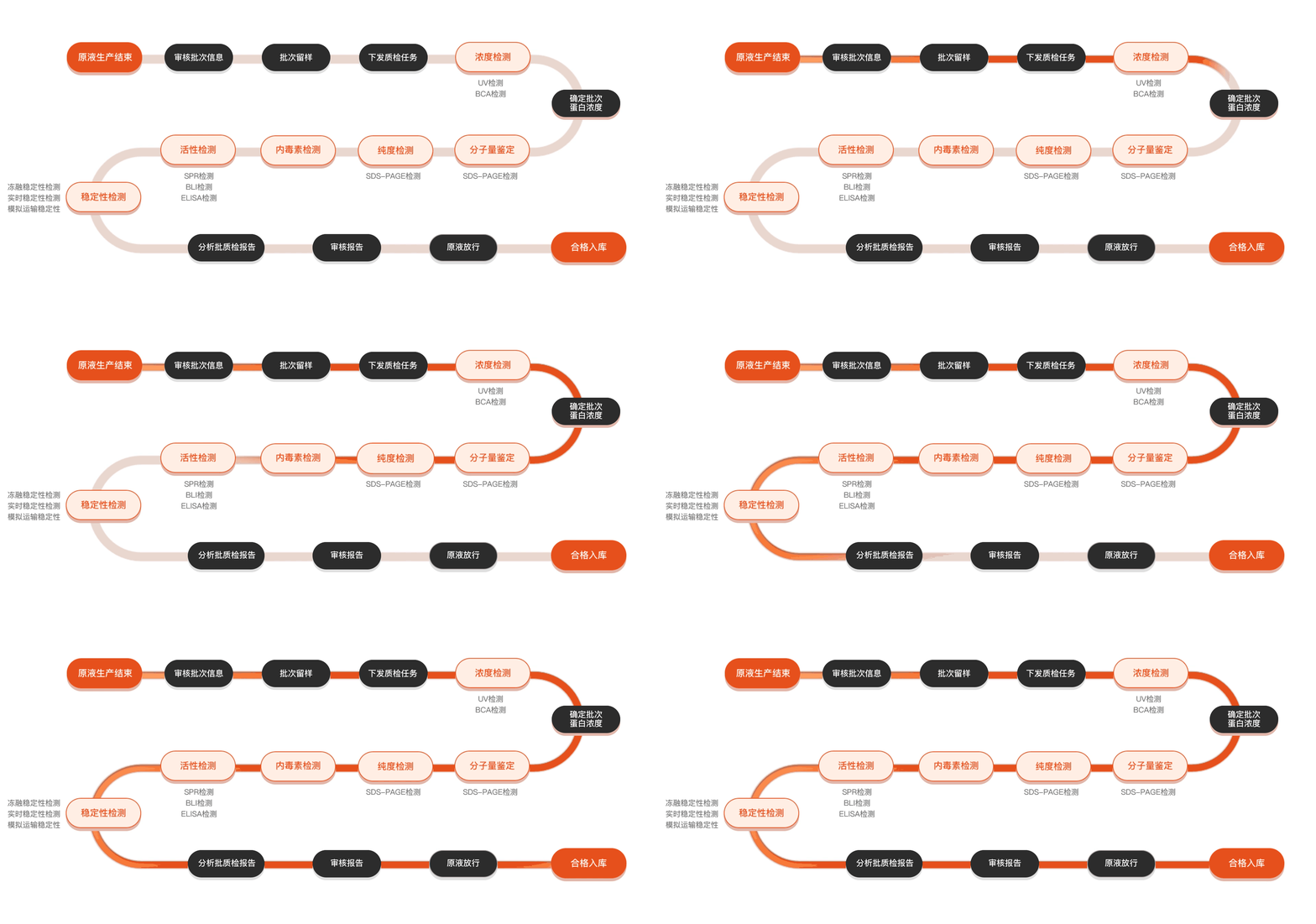
Quality inspection process
Related Products
Protein Description
3B recombinant protein, derived from the protein sequence of the 3B region of certain viruses, has garnered significant interest in the fields of virology and molecular biology. Research on this protein primarily focuses on its role in viral replication and pathogenesis, particularly in the context of RNA viruses. The 3B protein is often involved in the viral lifecycle, functioning in the replication complex and aiding in genome encapsidation. Understanding its structure and function can provide important insights into viral evolution and mechanisms of infection. Furthermore, 3B has been explored as a potential target for antiviral drug development due to its essential role in the virus's lifecycle. Researchers are utilizing advanced techniques such as X-ray crystallography and cryo-electron microscopy to elucidate the molecular mechanisms by which 3B interacts with other viral and host proteins. Studies also emphasize the importance of epitope mapping of the 3B protein to facilitate the development of diagnostic tools and vaccines. Given the ongoing global challenges posed by emerging viral infections, research on 3B recombinant proteins contributes to a broader understanding of viral behavior and opens avenues for novel therapeutic interventions.