

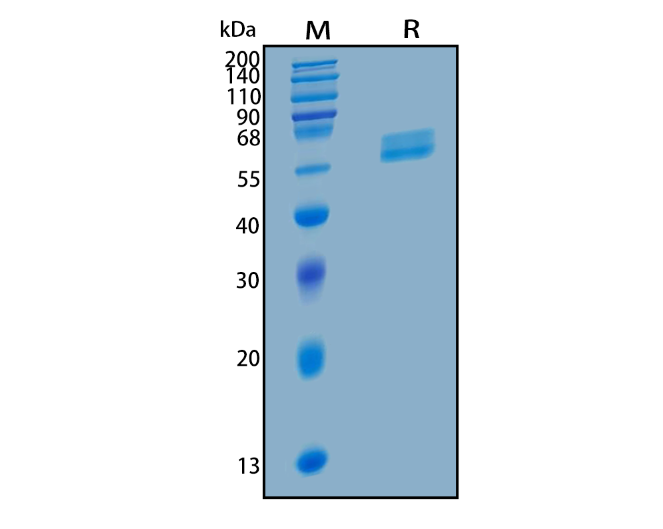
Analytical Data
-
Gene name
ALAD
- Application
-
Alternative Names
ALAD;Delta-aminolevulinic acid dehydratase
-
Species
Human
-
Source
E. coli
-
Tag
His tag N-Terminus
-
Purity
Greater than 90% as determined by SDS-PAGE.
-
Uniprot
P13716
-
Expression Region
1-330aa
-
AA Sequence
MGSSHHHHHH SSGLVPRGSH MGSHMQPQSV LHSGYFHPLL RAWQTATTTL NASNLIYPIF VTDVPDDIQP ITSLPGVARY GVKRLEEMLR PLVEEGLRCV LIFGVPSRVP KDERGSAADS EESPAIEAIH LLRKTFPNLL VACDVCLCPY TSHGHCGLLS ENGAFRAEES RQRLAEVALA YAKAGCQVVA PSDMMDGRVE AIKEALMAHG LGNRVSVMSY SAKFASCFYG PFRDAAKSSP AFGDRRCYQL PPGARGLALR AVDRDVREGA DMLMVKPGMP YLDIVREVKD KHPDLPLAVY HVSGEFAMLW HGAQAGAFDL KAAVLEAMTA FRRAGADIII TYYTPQLLQW LKEE
-
Molecular Weight
39 kDa
-
Endotoxin
< 1.0 EU per μg protein as determined by the LAL method.
-
Form
Freeze-dried powder
-
Buffer formulation
PBS, pH7.4, containing 0.01% SKL, 1mM DTT, 5% Trehalose and Proclin300.
-
Reconstitution
Reconstitute in ddH2O to a concentration of 0.1-0.5 mg/mL. Do not vortex.
- Customization
-
Stability Test
The thermal stability is described by the loss rate. The loss rate was determined by accelerated thermal degradation test, that is, incubate the protein at 37℃ for 48h, and no obvious degradation and precipitation were observed. The loss rate isless than 8% within the expiration date under appropriate storage condition.
-
Storage & Shelf Life
Samples are stable for up to twelve months from date of receipt at -20℃ to -80℃. Store it under sterile conditions at -20℃ to -80℃. It is recommended that the protein be aliquoted for optimal storage. Avoid repeated freeze-thaw cycles.
-
Shipping
In general, recombinant proteins are supplied as lyophilized powder and shipped at ambient temperature. For bulk packages, the proteins are provided as frozen liquid and shipped with blue ice, unless otherwise requested by the customer.
Quality inspection process

Related Products
Protein Description
ALAD (Aminolevulinic Acid Dehydratase) is an essential enzyme in the heme biosynthesis pathway, catalyzing the condensation of two molecules of aminolevulinic acid (ALA) to form porphobilinogen (PBG). Research on ALAD is crucial due to its role in the production of heme, an important component of hemoglobin, myoglobin, and various cytochromes, which are integral for oxygen transport and electron transfer in biological systems. Deficiencies or mutations in the ALAD gene can lead to porphyria, a group of disorders characterized by the accumulation of porphyrins, resulting in a range of neurological and gastrointestinal symptoms. Additionally, understanding the structural and functional properties of ALAD can offer insights into its enzymatic mechanisms and regulatory pathways. Advances in recombinant protein technology have enabled the production of ALAD in heterologous systems, facilitating the study of its biochemical properties, interactions with substrates, and potential as a therapeutic target. Moreover, recombinant ALAD may have applications in biotechnology and medicine, such as in the development of biosensors or gene therapy for porphyrias. Overall, research on recombinant ALAD protein not only enhances our understanding of heme metabolism but also opens doors for innovative therapeutic interventions in related disorders.







